Compostable bioplastics sector under threat. Urgent need for far-sighted regulations, systematic controls and actions to combat dumping by non-EU companies
The situation is being exacerbated by the economic dumping of products – particularly from Asia – the proliferation of illegal items and the phenomenon of ‘pseudo reusable’ tableware that circumvents rules against single-use products. Assobioplastiche and the Biorepack Consortium believe that defending this sector will guarantee the future of a production ecosystem that has established itself as a virtuous model and an example of industrial innovation.
Rome, 19 June 2025 – The compostable bioplastics sector is a source of pride in Italy and also serves as a virtuous example throughout the world. It owes its success to the tireless work of a number of pioneers, as well as regulations governing compostable carrier bags, which led to the expansion from 2012 of environmental policies aimed at combining economic growth with sustainable development. Hundreds of companies were created that invested massively in innovation, creating skilled jobs and expertise and giving rise to a circular bioeconomy model in which goods are followed from their production all the way to their organic recycling.
And yet the future of this sector is under threat. This is due not to any short-sightedness on the part of the businesses but rather to a series of external factors that require an urgent response: the competitive structure has been altered by significant imbalances between operators, an EU regulatory framework that is contradictory and incomplete and the lack of systemic controls to combat illegal activities.
The 2nd Italian Compostable Bioplastics Forum, held today in Rome by Assobioplastiche and the Biorepack Consortium, painted a disturbing picture. It was an opportunity for meetings between stakeholders, politicians and sector experts and a chance to present an up-to-date view of a sector which is essential for the Italian circular bioeconomy.
Key numbers from the sector
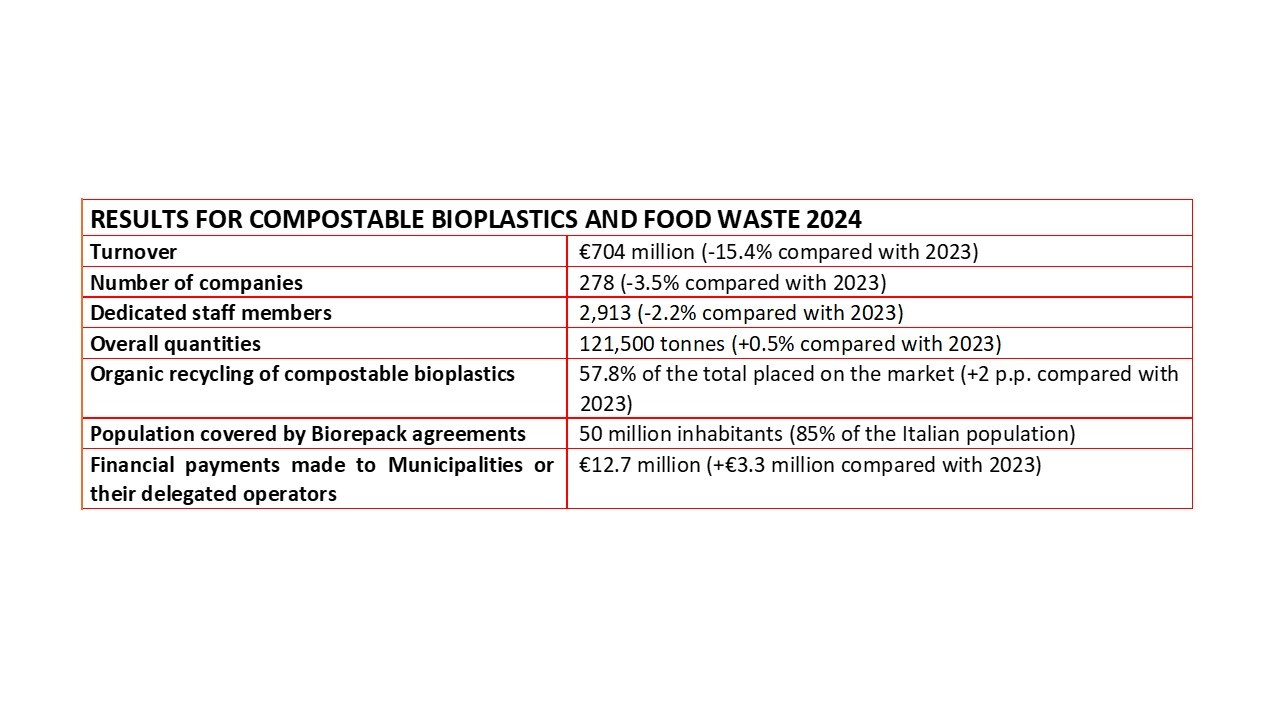
After a decade of uninterrupted growth between 2012 and 2022, the Italian bioplastics industry has seen a sharp reversal in the last two years. According to analysis by Plastic Consult, overall turnover fell to €704 million (15% lower than in 2023), even though volumes were slightly higher than in the previous year (121,500 tonnes, up 0.5% on 2023). The number of companies in the compostable bioplastics sector saw a slight drop: there are currently 278 companies, divided into basic chemicals and intermediates producers (7), granule producers and distributors (22), primary processors (189) and secondary processors (60). There was also a slight drop in the number of dedicated staff (the employees working for companies in the sector directly responsible for products that enter the compostable plastics chain), now totalling 2,913, a decline of 2.2% from the previous year.
The results for organic recycling of compostable bioplastics were much more positive, confirming an upward trend: in 2024 the recycling rate, excluding rejects, was 57.8% of the total placed on the market (47,511 tonnes recycled out of 82,246 tons placed on the market). This result bettered the recycling goals set for 2025 (50%) and 2030 (55%).
Significant growth was also seen in the number of municipalities and territories adhering to the Biorepack Consortium (up from 58.5% to 74.3% in a single year, an increase of 15.8 percentage points) and in the population covered, which currently stands at over 85%, 11 percentage points higher than the 74.1% total in 2023. Consortium members received financial payments of €12.7 million (over €3 million more than the previous year) to cover their costs in collecting, transporting and processing compostable bioplastic packaging disposed of together with domestic organic waste.
The obstacles ahead
One particular cause for concern is the arrival on the European market of carrier bags and items made from compostable bioplastic imported at exceptionally low prices, causing serious issues for Italian companies and distorting competition.
“Today, purchasing a finished product made of compostable bioplastic manufactured outside the European market costs less than buying the raw materials needed to produce it in Italy or in any other European country,” explained Luca Bianconi, president of Assobioplastiche. “Non-EU companies – primarily based in Asia – often benefit from public subsidies, extremely low labor costs, and less stringent regulations than those in Europe. All of this creates unsustainable competitive pressure for our companies. Until a few years ago, a significant share of bioplastic products sold in Europe was manufactured by European companies. Today, that share has gradually decreased. Although Europe's production capacity remains high, in several sectors it is currently underutilized."
Among the reasons for this distortion of competition is the long-standing issue of ‘pseudo reusable’ tableware, which is marketed by exploiting a loophole in the SUP (Single Use Plastic) directive. Although the regulation prohibits single-use items, it does not provide detailed specifications on what constitutes a reusable item, thus allowing companies to circumvent the rules, to the detriment of legitimate businesses. Having recently sent the EU a technical proposal for the definition of reusable items, Italy is currently awaiting comments. Another factor is the proliferation of illegal carrier bags, which still make up over a quarter of all bags circulating in Italy, ten years since fines were introduced.
Against this backdrop, crucial new legislation has been introduced: the new European Packaging and Packaging Waste Regulation (PPWR), which brings in important prospects for compostable bioplastics but also imposes strict deadlines with complex and challenging management requirements.
It is essential for Italy to fully exploit the potential of the PPWR, providing without delay a list of the applications that must be made using compostable bioplastics. This list must come into force by 11 August 2026 and will pave the way for similar regulations in other EU countries. This would help provide certainty to operators producing and using the packaging in question and would also provide clarity to consumers and simplify the procedures for proper disposal of organic waste.
"To ensure the correct operation of a model that has already shown its economic and environmental worth, we need a small number of rules that are certain, clear and enforced. As a recycling consortium we will continue to pursue our commitment to meeting recycling targets, working hand in hand with all players in the sector, starting with the composting industry, to ensure a virtuous way of closing the compostable packaging cycle,” said Marco Versari, president of the Biorepack Consortium.
PRESS INFO:
for ASSOBIOPLASTICHE
Giuseppe Iasparra
[email protected]
Mob. +39 349 084 2408
for CONSORZIO BIOREPACK
Barabino & Partners S.p.A.
Serena Galdo - [email protected] - Mob: +39 345.14.64.356
Domenico Lofano - [email protected] - Mob: +39 334.14.12.995